



I am, by upbringing, a Confucian. I am, by nature, a Taoist. I am, by outlook, a Puritan. I’ll leave it at that.
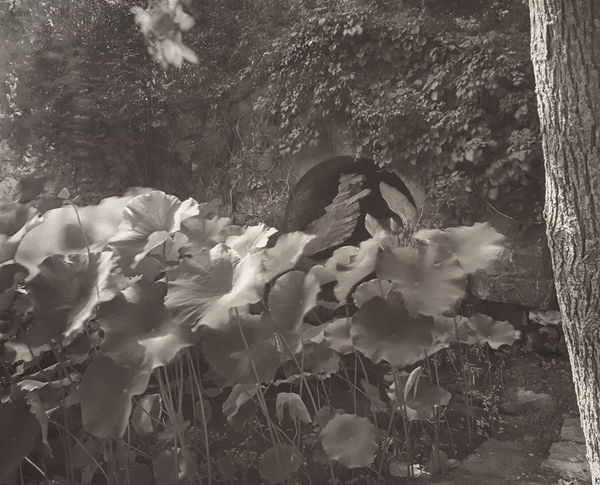
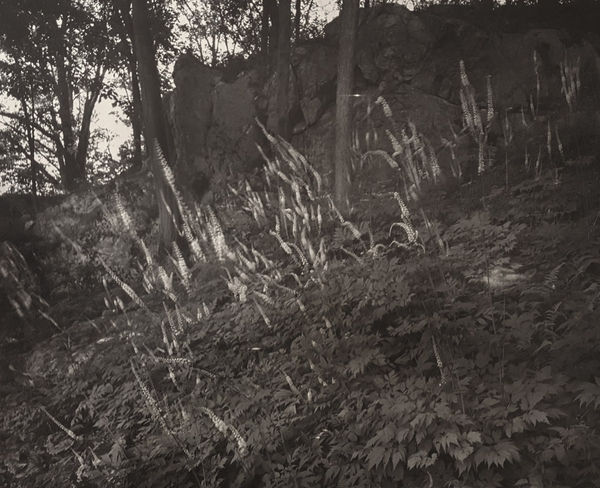
John Yang (1933–2009) photographed the architecture and streets of New York as well as the surrounding landscape and gardens. Using traditional equipment and alternative darkroom techniques, he produced exquisite large format contact prints, often toned rich magentas: 11" x 14", 8" x 10", 5" x 7" and 10" x 78" panoramas. All work was printed by Yang himself.
The John Yang Archive is at The Center for Creative Photography at University of Arizona, Tucson. John Yang's work is in the permanent collections of The Metropolitan Museum of Art, The Smithsonian American Art Museum, The Musuem of Modern Art, The New York Public Library, The High Museum, Atlanta, the Chasanoff Collection at the Museum of Fine Arts, Houston, and other public and private collections of photography.
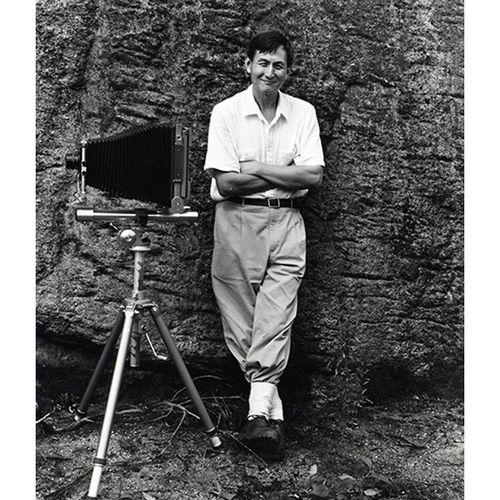
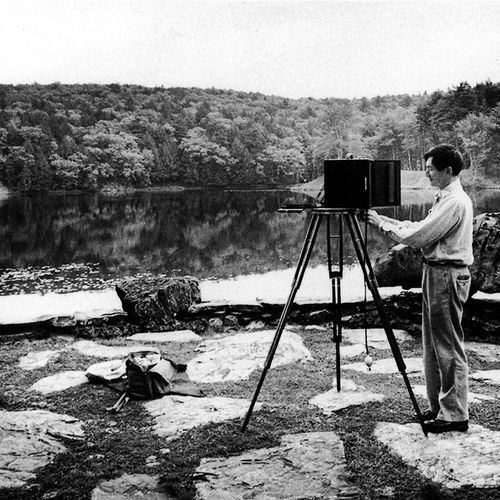
John Yang was born April 16, 1933, in Suzhou, China. His father was a doctor educated in Germany; his grandfather, a successful Shanghai businessman. His family emigrated to England in 1937, and then to America in 1939. Yang grew up in New York City. He was a naturalized U.S. citizen.
When he was 13, he received his first camera, an Argoflex, a present from his father. He was smitten and thereafter hooked on photography. His first published picture (a winter landscape) appeared on the cover of his school magazine. He was initially attracted to the work of the Pictorialists, and later to that of the Purists (Weston, Strand and Cartier-Bresson — through MOMA's monographs). "America and Alfred Stieglitz," a book of essays about Stieglitz and his time, made a lasting impression upon him.
In 1951, after his freshman year at college, Yang traveled cross-country to take Minor White's summer class at the California School of Fine Arts in San Francisco. He was taught the rudiments of view camera technique and Ansel Adams' Zone System. White would on occasion show his own photographs in class. They were usually works in progress, and always shown without comment. Yang especially admired White's sequence of seascapes taken along the California coast.
Yang went to Harvard College, majored in Philosophy, and graduated in 1954. His thesis, "The Philosophy of the Present," was about the American philosopher George Herbert Mead. He went on to the University of Pennsylvania where he obtained his professional degree in architecture in 1957. He then served a stint in the U.S. Army in Germany, where he bought a Leica, his first 35mm camera. After his discharge, he remained in Europe to take photographs.
Upon his return to New York, he commenced his practice of architecture, first as a draftsman, and eventually as a partner in his own architectural firm: Holden, Yang, Raemsch & Corser. Although he liked designing private houses, the bulk of his practice consisted of public housing and institutional projects. He photographed for publication the buildings he designed, and when he found the time, took pictures for himself. Many were of his wife and children.
Yang had his first solo exhibition at Norbert Kleber's Underground Gallery in New York in 1965. The pictures were taken in a fishing village in Brittany, France. In that same year, the Museum of Modern Art bought a photograph of his and included it in its exhibition, "New Acquisitions." This was his first sale of a photograph. In 1967, he was included in the Metropolitan Museum of Art's exhibition, "Photography in the Fine Arts." At his second exhibition at the Underground Gallery in 1969, he showed pictures taken in his lunch hours in the streets around where he worked.
A portfolio of his photographs was featured in 1969, in "Infinity," the magazine of the American Society of Magazine Photographers (ASMP); and in 1978, a gravure portfolio, "Visions of Innocence," featured in "Popular Photography" magazine.
In 1978 Yang retired from architectural practice.
From 1979 to 1990, Yang was represented by the Marcuse Pfeifer Gallery in New York. His exhibition in 1981, "Landscapes-Westchester Co, Fairfield Co, Lake Mohonk," presented his "calligraphic" studies undertaken in the parks, nature preserves and sanctuaries (his "wild gardens") in the New York metropolitan region.
His exhibitions, "Innisfree Garden" in 1986, and "The Golf Course as Landscape Art" in 1989, featured extended panoramic photographs resembling Chinese scroll paintings. However, the photographs were meant to be viewed as a whole, and not , as with scrolls, sequentially in part. The photographs were taken with a Cirkut No. 10, a spring-powered rotating camera built in 1903. In its 360- degree scans, the camera records a scene from within the scene itself.
From 1989 through 1993, Yang photographed the ornamental sandstone relief portraits over the doorways of New York City's brownstones and remaining tenements. This project culminated in his first book, "Over the Door: The Ornamental Stonework of New York" (Princeton Architectural Press,1995).
From 1994 to 1997, Yang photographed the miniature photographic portraits, called ‘enamels,' placed on the tombstones of Mount Zion, an orthodox Jewish cemetery sandwiched between the Long Island Expressway and a Sanitation plant in Queens, New York. This project resulted in his second book, "Mount Zion: Sepulchral Portraits" (D.A.P., 2001).
Starting in 2001, Yang photographed John Boyd Thacher State Park near Albany, New York. The park is situated on the Helderberg Escarpement, a long and prominent ridge overlooking the Mohawk-Hudson Valley. A path, called the "Indian Ladder Trail," once traversed the ridge. With an 11" x 14" view camera, Yang photographed along the remnant of the trail which today lies within the boundaries of the Park. John Yang died September 28, 2009.