


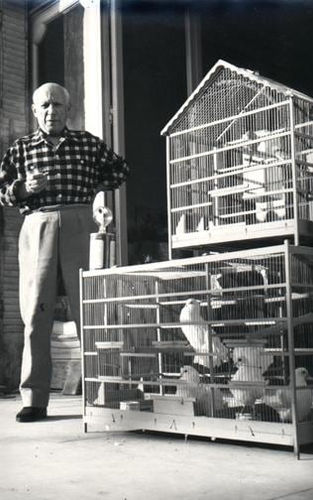
Lucien Clergue grew up surrounded by Greek and Roman ruins as well as those caused by World War II. Early in 1955, Clergue choreographed a series of photographs of traveling entertainers, acrobats, and harlequins entitled the Saltimbanques. The photographer created tableaux vivants, sometimes making the costumes for the players himself. Clergue’s earlier work also included images of gypsies of southern France. After sending images to Pablo Picasso, Clergue finally met and formed a close friendship with the artists that endured until Picasso’s death. Through Picasso he met poet, writer, and filmmaker Jean Cocteau, with whom Clergue collaborated on several projects. Clergue’s imagery developed three strong themes: female nudes, bullfighting, and Picasso and his circle.
Clergue’s photographs have been exhibited in over one hundred solo exhibitions worldwide. The Fogg Museum at Harvard University and the Museum of Fine Arts in Boston have become the major repositories for Clergue’s work. His photographs of Jean Cocteau are on permanent display at the Jean Cocteau Museum in Menton, France. He has published more than seventy-five books and twenty short films.